The Glitch Is the Gift: What My Failed Ink Washes Taught Me About American Hunger for the Real
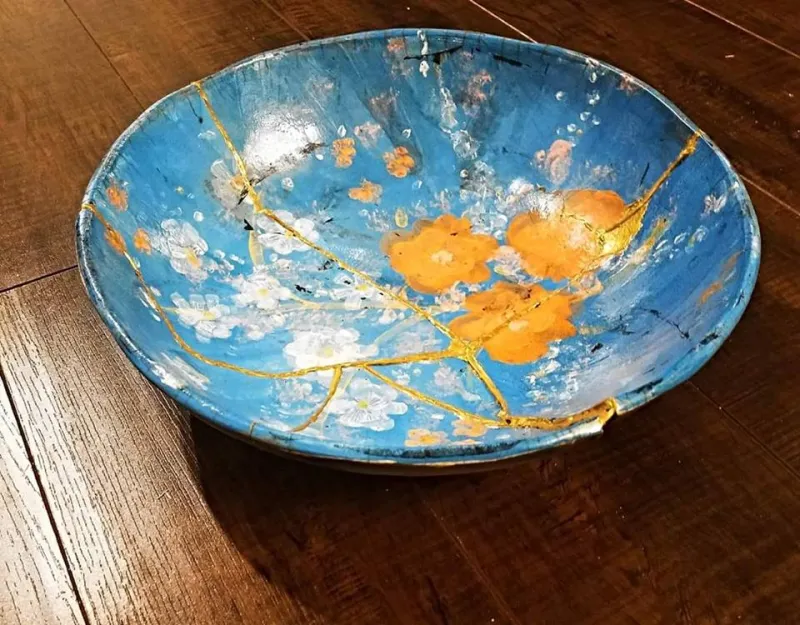
Photo: Ruthann Hurwitz, CC BY-SA 4.0, via Wikimedia Commons
Last spring, I spilled tea on a nearly finished ink painting. Not a charming, controlled spill—half the cup, straight onto three weeks of work. I did what any reasonable artist would do: I almost threw it away. Then I hung it on my studio wall instead, and something strange happened. It became the piece everyone asked about.
That accident got me thinking about a pattern I've noticed over the past few years, especially with my American collectors and followers: the more polished the feed gets, the more people reach for the frayed edge.
The Algorithm Wants Symmetry. Humans Want Scars.
If you've spent any time on Instagram or TikTok lately, you know the aesthetic: perfect lighting, perfect color grading, perfect symmetry. It's beautiful the way a hotel lobby is beautiful. And like a hotel lobby, it starts to feel like nowhere at all.
Wabi-sabi—the Japanese sensibility that finds beauty in impermanence, imperfection, and incompleteness—exists as almost a direct rebuttal to this. It's the tea bowl with the visible repair. The weathered wooden gate. The garden that's pruned to look like it wasn't pruned.
Here's what I've come to believe: when Americans say they want "authenticity" from creators, they're not asking for confessional vlogs or behind-the-scenes bloopers. Those are just authenticity as content, which is to say, authenticity performed. What they're actually reaching for is wabi-sabi—work that carries evidence of a human hand and a specific moment in time.
My Favorite Mistakes (A Short Inventory)
I keep a folder of what I call my "failed keepers," and three of them taught me more than any finished piece.
The cracked plate series. I started photographing kintsugi-repaired ceramics on the kitchen tables of friends here in the States. The best image in the series wasn't the elegant repair job—it was a cheap diner plate I'd broken myself, glued badly, and shot under harsh fluorescent light. The repair was ugly. The photo was devastating. People kept asking where the "sadness" came from. It came from the honesty.
The overexposed window. Shooting in a Brooklyn studio, I let a roll of film get overexposed by accident. The highlights blew out into this soft, foggy white that looked like breath on glass. I've tried to recreate it deliberately maybe a dozen times. It never works. That's the wabi-sabi paradox: the imperfection can't be manufactured on purpose, or it stops being one.
The unfinished track. I released a lo-fi piano loop with a recording artifact in it—a chair creak, faintly, at 0:47. A listener emailed to ask what the "sample" was. There was no sample. There was just my old chair and my refusal to do another take.
Why Now? Why Here?
Japan didn't corner the market on imperfection—American quilts, blues music, and folk pottery all carry the same DNA. But the philosophy of wabi-sabi gives us a vocabulary for it, and vocabulary matters.
I think three things converged to make this land differently in the US right now:
- AI-generated perfection became free and infinite. When flawless images cost nothing, flawless stops signaling care. The imperfect thing becomes the only proof of a person behind it.
- The "clean girl" and cottagecore aesthetics peaked and curdled. Even our imperfection trends got sanded down into looks. People are learning to tell the difference between imperfection as decoration and imperfection as truth.
- We're all tired. There's a quiet exhaustion in performing a life that looks finished. Art that admits it isn't finished feels like permission.
Practicing the Glitch on Purpose (But Not Really)
I want to be careful here, because there's a fake version of this advice circulating: "add grain to your photos, use a distressed font, look artisanal." That's just imperfection as another filter.
Real wabi-sabi practice is slower and stranger. Some things that actually work for me:
- Stop at 90%. Leave the piece one revision short of done. Sit with the discomfort.
- Keep the first take. Or at least one first take per project. The unguarded version often has something the guarded ones lack.
- Let the medium disagree with you. Ink bleeds. Wood warps. Film expires. Instead of fighting the material's opinion, let it outvote yours occasionally.
- Show the work before you've decided it's good. The audience can smell the difference between sharing and launching.
The Bowl Is Still Cracked
I won't pretend a philosophy from 16th-century tea masters is a cure for digital burnout. But I've noticed that when I post the flawed pieces—the spilled tea painting, the creaky piano loop—the comments change. They get longer. More personal. People tell me about their own cracked things.
That's the whole secret, maybe. Perfection invites admiration. Imperfection invites company.
So the next time your work comes out wrong—the print misregisters, the recording hums, the glaze crawls—before you reach for the delete key, try looking at it the way you'd look at a repaired bowl. Not "what's broken?" but "what did the breaking add?"
The tea stain is still on that painting. It's the most expensive accident I never paid for, and the piece I'll never sell.