The Playlist Where Nothing Gets Deleted: Streaming My Skips Like Gold
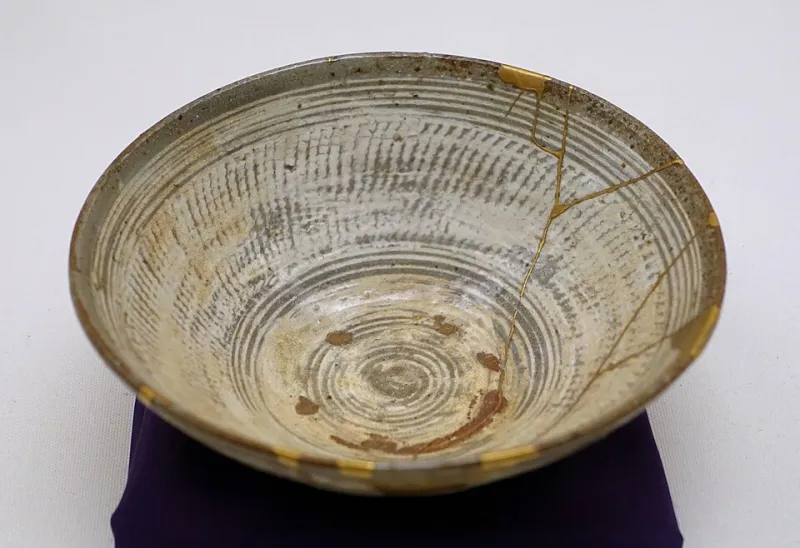
Photo: Daderot, CC0, via Wikimedia Commons
There's a moment on my public playlist, track fourteen, where you can hear my neighbor's dog bark. Right in the middle of the chorus. A raw, unapologetic bork that no mixing engineer would ever let survive.
I kept it.
The Delete Button Is a Lie
Here's what streaming culture quietly taught us: every playlist is a highlight reel. We curate like we're applying for a job. Polished singles, algorithm-friendly runtimes, nothing that wobbles. If a track stumbles, we skip it. If a demo embarrasses us, we bury it in a folder called "old stuff" and pray nobody finds it.
I grew up around kintsugi — the practice of repairing broken pottery with lacquer dusted in gold. The point was never to hide the break. The point was to make the break the most beautiful part of the object. A repaired bowl doesn't pretend it never fell off the shelf. It says, out loud, I fell, and I'm still here, and look at this gold seam.
Somewhere between Kyoto and my Brooklyn apartment, I realized my music library had become a shelf of unbroken, unlived-in bowls. Nothing on it had ever cracked. And nothing on it felt like mine.
Building the Kintsugi Playlist
So I made a rule for myself: one public playlist where nothing gets deleted. Ever. I call it my kintsugi playlist, and here's how it works.
Every skip stays. The track I abandoned at forty seconds because the key change didn't work? It's there, mid-list, right between two songs I actually love. The skip is a document of a decision. Deleting it erases the decision.
Unfinished demos go public. There's a ninety-second voice memo on there — just me humming over a cheap keyboard, recorded on the L train platform in Williamsburg. It goes nowhere. It ends abruptly. It's also, honestly, the track people message me about most.
Live takes beat studio takes. When I have both, the playlist gets the version where my voice cracks on the high note and someone in the back of the room laughs. The crack is a timestamp. It proves a room existed.
Order is chronological, not curated. No flow, no arc, no DJ brain. The playlist sounds like a life, which means it sounds messy. Playlists that "flow" are liars. Lives don't flow.
What Happened When People Started Listening
The first month, it was mortifying. Every time someone followed the playlist, I imagined them hitting track fourteen and the dog. I nearly deleted the whole thing twice.
Then the messages started. A kid in Ohio told me the unfinished train-platform demo made him feel less alone in his own half-finished songs. A friend admitted she'd been hiding her own demos for six years and sent me three of them the same night. Strangers started skipping less — the average listen-through got longer, not shorter, once the flaws went on display.
That's the thing nobody tells you about gold seams: people don't avert their eyes. They lean in.
Against the Sterile Queue
I'm not anti-polish. I love a pristine mix as much as anyone raised on radio. But there's a difference between craft and sterilization, and streaming has quietly confused the two. When every queue is optimized, every skip pattern analyzed, every track chosen to prevent churn, listening stops being an act of trust. You're not hearing a person. You're hearing a retention strategy.
Kintsugi is the opposite gesture. It says: this object has a history, and I refuse to sand it down. Applied to a playlist, it means your listening life gets to have scars. The song you loved at nineteen that makes you wince now. The live take with the bad crowd. The demo that ends because your phone rang.
Keep them where people can see. Dust the seams in gold.
Try This Tonight
If you want to build your own, start small. Make one playlist, public, and add three things you'd normally hide: a skip, a rough take, a song you outgrew. Don't reorder it. Don't add cover art that explains it. Just let it sit there, broken and shining.
Then — and this is the hard part — leave it alone for a year.
Somewhere around month three, you'll stop hearing the flaws as failures. You'll hear them as evidence. That you made things. That you changed your mind. That a dog barked once, mid-chorus, in a life that was actually happening.
The bowl that never broke tells you nothing. The one with gold in the cracks tells you everything.