Vinyl on the Walls, Jazz in the Dark: Borrowing My Grandmother's Kyoto Listening Room for a Brooklyn Basement
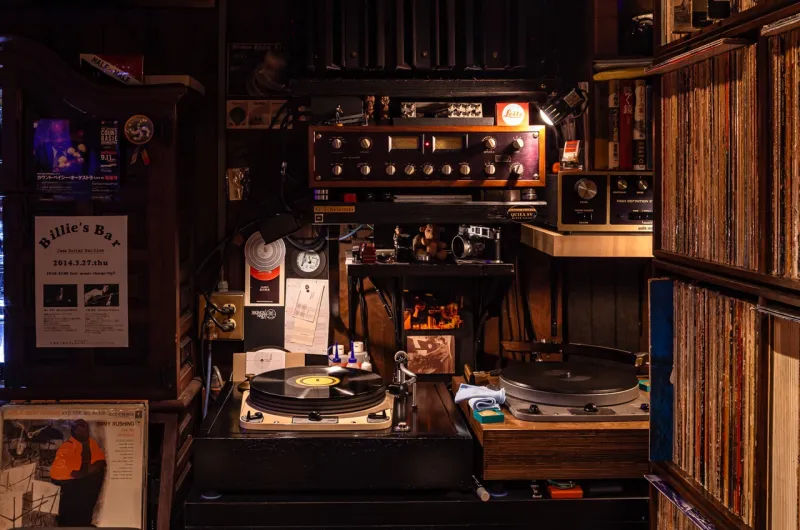
Photo: dim moody japanese jazz kissa cafe interior with vinyl records and vintage speaker, via trackingangle.com
My grandmother's coffeehouse in Kyoto had no windows worth mentioning, and that was entirely on purpose.
It was a kissaten — specifically a jazz kissa, one of those dark-wood sanctuaries that proliferated across postwar Japan, where coffee was brewed with religious seriousness and a single, obsessively placed speaker turned an ordinary afternoon into a listening ceremony. She ran hers for four decades. I spent last winter photographing it before the lease changed hands, shooting the way light fell across the turntable at 3 p.m., the way the vinyl shelves seemed to hold up the ceiling.
Now I'm helping convert a Brooklyn basement into a small listening room — the kind of venue New York keeps trying to kill and music lovers keep resurrecting. Flipping through my contact sheets, I realized my grandmother had already written the design brief. Here are the seven principles I'm carrying across the Pacific.
1. One Speaker, Placed Like a Sculpture
The heart of her café was a single full-range speaker, positioned in the corner like a Shinto shrine, angled so that every seat heard roughly the same sound. No stereo spread. No audiophile flexing. One voice, filling one room.
The Brooklyn translation: Resist the urge to install a surround system. A single high-quality speaker — or a centered mono pair — forces the room into a shared sonic focal point. Everyone leans toward the same source. That's not a limitation; that's community architecture.
2. Lighting That Says 'Listen, Don't Look'
Jazz kissas run dim. Not romantic-dinner dim — listening dim. My grandmother kept the lights low enough that conversation dropped to a whisper and the music moved to the center of attention. She called it "turning the room inward."
The Brooklyn translation: Cap your ambient lighting around 2700K and keep fixtures below eye level. Table lamps, not downlights. When the room darkens, the ears take over. Every serious listening bar in Tokyo — and the good ones in New York, like the handful following the kissa playbook — understands this.
3. Vinyl as Load-Bearing Décor
The LP shelves at her café weren't storage. They were the interior design. Thousands of spines, sorted by her own cryptic logic, visible from every seat. Customers browsed the walls between records, and browsing begat requests, and requests begat conversations with strangers.
The Brooklyn translation: Put the collection on display, not in crates behind the bar. Visible vinyl is an interactive museum and a conversation starter. In a city where everyone's apartment is the size of a kissa booth, let the venue's walls be the collection people can't have at home.
4. Seating for Eavesdropping on the Music, Not Each Other
Her counter seating — a long wooden bar facing the turntable — was the best in the house. You sat facing the music the way you'd sit facing a chef. The tables along the walls were for regulars; the counter was for pilgrims.
The Brooklyn translation: Build at least a few seats that face the sound source directly. A listening room isn't a bar with background music; it's a theater with drinks. Orient the furniture like you mean it.
5. The Coffee Is Part of the Sound System
My grandmother insisted the siphon brewer's gurgle belonged to the room's acoustics — a percussion instrument between songs. She was half joking. The other half was dead serious: nothing in a kissa is incidental, including the ritual of the pour.
The Brooklyn translation: Make one preparation theatrical. A pour-over station, a manual espresso ritual, even a visible vinyl-cleaning routine between records. Give the room a heartbeat that isn't a screen.
6. Signs That Ask Rather Than Command
There was no "NO TALKING" placard. Instead, a small handwritten card by the turntable read: "The record is speaking. Please let it finish." Politeness did the enforcement that signage usually does with aggression.
The Brooklyn translation: Write your house rules in a human voice. "The artist drove four hours to play for us" lands softer and sticks harder than a laminated warning. Americans respond better to invitation than prohibition — frame silence as a gift, not a rule.
7. A Room That Photographs Honestly
I photographed her café for a month, and the pictures taught me something the space itself never announced: nothing in it was staged for the camera. The patina was earned. The shadows were structural. It photographed beautifully because it was built for staying, not for posting.
The Brooklyn translation: Design for the people in the room, and the Instagram shots will take care of themselves. A listening space that's lit and arranged for the phone camera will feel hollow to everyone actually sitting in it. My grandmother never once thought about how her café looked in a photo. Every photo of it looks like a place you wish you'd been.
The Basement, So Far
The Brooklyn build-out is months from done. But the single speaker is ordered, the dimmers are installed, and a hand-lettered version of my grandmother's turntable card is already framed by the door.
When we open, I'll hang one of my winter photographs of her café above the counter — a window's worth of Kyoto light in a room that deliberately has none. If she taught me anything, it's that a listening room isn't built from equipment.
It's built from attention.