You Give Me a Feeling, I Give You a Song: Notes From My Omakase Commission Experiment
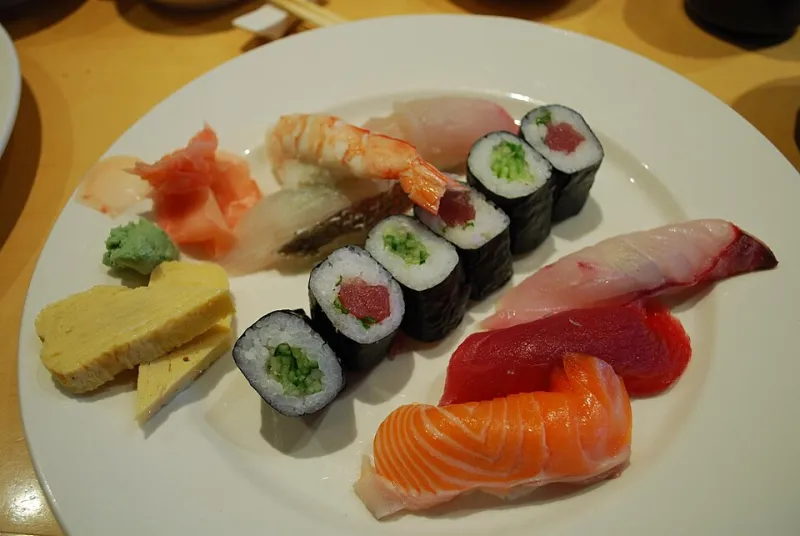
Photo: Alpha from Melbourne, Australia, CC BY-SA 2.0, via Wikimedia Commons
There's a moment at every sushi counter in Tokyo when the customer stops being a customer. The chef looks at you, glances at what came in that morning, and simply begins. You didn't order anything. You don't get to. That's omakase — literally, "I leave it up to you" — and it works because of one strange, beautiful transaction: you hand over control in exchange for the chef's full attention.
Last spring, I decided to find out whether that transaction could survive being translated into music, in America, over the internet. Spoiler: it mostly can. But not for the reasons I expected.
The Rules of the Counter
The setup was simple, and I posted it on my studio site with the gravity of a legal contract:
- Send me a mood, a photograph, or a true story. No genre requests. No reference tracks. No "make it sound like X meets Y."
- I compose one piece based on what you sent.
- You receive the track. There are no revisions. There is no second draft.
I capped it at five commissions. I figured I'd get three takers, maybe four. I had forty-one submissions by the end of the week.
What People Actually Sent
The submissions were better than any brief I've ever received from a client, and I've had plenty. Americans, it turns out, are bursting with unsent feelings.
Track one: "Salt on the Windshield." A woman in Ohio sent a photo of her late father's truck, shot through a frosted windshield at 6 a.m. I built the whole piece around a detuned upright piano and the sound of my own breath against a cold mic. She told me later she plays it on her commute. I did not ask which parts she skips, because there are no parts to skip. That's the deal.
Track two: "Third Shift Bodega Light." A nurse in Queens described the particular hum of the corner store at 4 a.m. after a brutal shift. This one went almost entirely analog — tape hiss, a bassline that never quite resolves, the audio equivalent of fluorescent light. No chorus. Choruses felt dishonest for that one.
Track three: "My Daughter's Laugh, Slowed Down." The title is the brief. I won't pretend I didn't cry composing it. I also won't pretend it's finished, because under omakase rules, it can't be finished — it can only be served.
Track four: "Everyone Left the Party But the Music Was Still Good." A twenty-something in Austin sent four sentences and nothing else. I made something bright and slightly broken, a track that keeps almost ending and refusing to.
Track five: "Grandpa's Workbench, Sold at Estate Sale for $40." The angriest and tenderest brief. I sampled an actual hand saw, tuned it, and let it argue with a koto loop from an old session of mine. Two instruments from different worlds, disagreeing beautifully.
Why No Revisions Is the Whole Point
Here's what I learned: the revision request is where trust goes to die. Not because clients are wrong — often they're right! — but because the moment you can send something back, the piece stops being a gift and becomes a product. Products are safe. Gifts are terrifying. And terrifying is where the interesting stuff lives.
We live in the most on-demand culture in human history. My American listeners can skip a song in four seconds, reorder a playlist, swipe past anything that doesn't immediately flatter their taste. Every algorithm knows them better than their mother does. And yet every single person who submitted told me some version of the same thing: "I just want to be surprised by something."
Surprise requires surrender. You cannot be surprised by a thing you pre-approved.
The Ma in the Middle
In Japanese aesthetics there's the idea of ma — the meaningful emptiness, the pause that gives shape to what surrounds it. Omakase is full of ma. The chef's silence. The wait between courses. The space where your expectations used to be.
Composing without the possibility of revision filled my process with ma too. I couldn't sand off the weird edges, so the weird edges stayed. Track two has a moment where the bass just... stops, for eleven seconds, because that's what 4 a.m. at a bodega actually feels like. A producer would have cut it. The client, presumably, will have to sit inside it. I envy her that.
Would I Do It Again?
Yes, but slowly. The no-revisions rule held up better than I expected — only one person asked, gently, for a change, and when I reminded them of the deal, they wrote back: "You're right. I'll live with it." A week later: "I think it's my favorite thing anyone's ever made me."
That's the secret, I think. Americans don't actually want more control. They're drowning in control. What they want — what we all want — is one small corner of life where someone else is paying full attention, and the only thing required of us is to receive it.
The counter is open again this fall. Send me a feeling. I'll send back a song. No take-backs, and that's the good part.