The Day I Unplugged My Studio: Notes on Silence, Ma, and Making Things in America
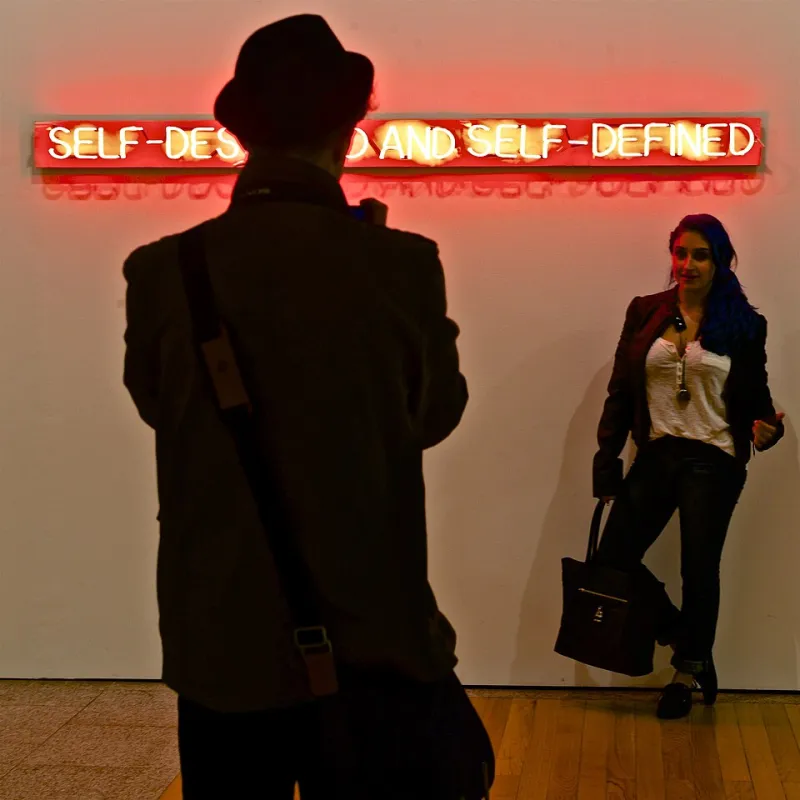
Photo: Pedro Ribeiro Simões from Lisboa, Portugal, CC BY 2.0, via Wikimedia Commons
My studio in Portland has good bones. Big north-facing window, a battered oak desk I hauled across the Pacific, a wall for pinning prints. For the first year, though, I couldn't finish anything in it.
I blamed the move. I blamed the light. It took me embarrassingly long to blame the music.
The Room That Never Stopped Talking
Like most American creatives I know, I had built a life with zero dead air. Lofi playlists while editing. A podcast while developing film scans. The TV on for company while sketching. Even my walks had narration. I wasn't consuming this content because I loved it — I was using it as insulation, a warm hum between me and my own thoughts.
In Japan, I had never worked this way. My teacher in Kyoto used to make students sit for a full minute before we touched our brushes. She called it clearing the ma — the interval, the pause, the space between things. I thought of ma back then as a visual concept, the emptiness in a painting that gives the subject room to breathe. I hadn't understood that ma also lives in time.
And I had filled every second of mine.
What Ma Actually Means (and What It Doesn't)
Western design writing tends to translate ma as "negative space," which is technically right and spiritually wrong. Negative space sounds like absence. Ma isn't absence — it's an active ingredient. The pause in a Noh play that holds more tension than the dialogue. The gap between two notes that makes a melody sing instead of grind.
The pause isn't empty. It's load-bearing.
When I finally admitted this, the experiment was almost stupidly simple: no music, no podcasts, no background anything in the studio. Just the radiator, the rain, and me.
Before and After: My Own Field Notes
Before (the playlist era):
- Editing sessions averaged about 45 minutes before I'd drift to my phone
- I rejected maybe 80% of my frames, mostly out of restlessness rather than judgment
- My music sketches all converged on the same mid-tempo melancholy — the playlists were leaking into the work
- I felt permanently busy and perpetually behind
After (three months of quiet):
- The first week was genuinely uncomfortable. Silence has a volume, and at first it's loud.
- By week two, I could sit with a bad print for twenty minutes before deciding what was wrong with it. That patience fixed problems I'd been papering over for a year.
- My photography slowed down. I started waiting for light instead of manufacturing compositions. One image from that period — a single chair by the window at 4pm — became the anchor of my last series.
- The music changed too. With nothing filling the gaps, the phrases I hummed got longer, with real rests in them. Turns out I'd never written a rest in my life. Now they're my favorite part.
For My Chronically Overstimulated American Friends
I don't think the problem is you. I think the problem is that the US creative economy treats every unoccupied moment as inventory — something to be filled, monetized, or at least optimized. Silence reads as wasted time. But a creative practice runs on unoccupied moments. That's where taste gets made.
If you want to try it, here's what worked for me:
- Pick one room, one hour. Not your whole life. One hour in the place where you make things, with nothing playing.
- Expect the withdrawal. The first few sessions feel like standing in an empty gallery. That itch to reach for your phone is the whole point — notice it, don't obey it.
- Let boredom do the editing. Some of my best cuts came from simply sitting with a piece long enough to stop defending it.
- Protect the pause in the work itself. Leave a beat of dead air in your track. Let a photo breathe with empty space. Don't fill what you've fought to empty.
Still Not Zen About It
I want to be clear: I'm not selling silence as enlightenment. I still love a good album. I've just moved it out of the studio and back into my life, where it belongs — something I choose, not a drip-feed I marinate in.
Ma, it turns out, was never about the room being quiet. It was about me being willing to hear what's there when nothing else is talking. In a country that sells you noise by the gallon, choosing the pause might be the most rebellious thing an artist can do.
The radiator just clicked on. Rain on the window. My brush is wet.
That's enough soundtrack for me.