The Table That Kept Its Wounds: A Season of Repairing Instead of Replacing
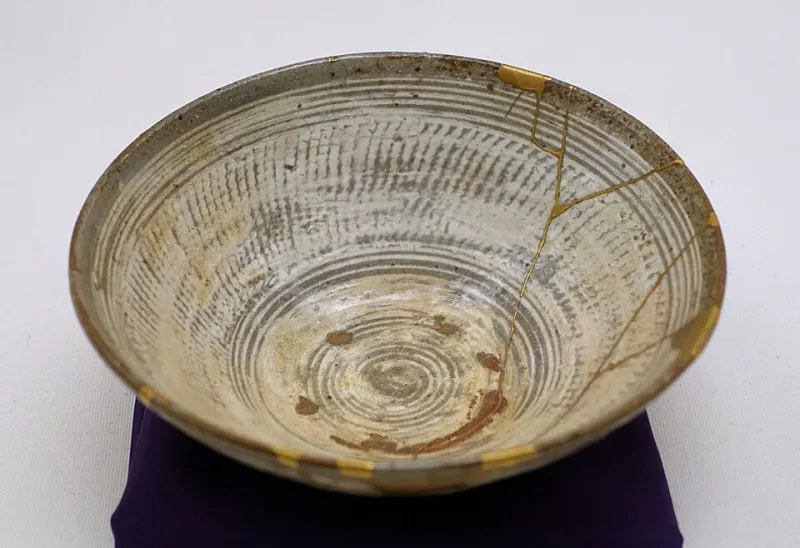
Photo: Daderot, CC0, via Wikimedia Commons
The table broke on a Tuesday. Of course it did. A cheap particle-board thing from IKEA, maybe four years old, split down the middle like it had been waiting for permission. My first instinct — the American instinct, the one I've absorbed like secondhand smoke — was to photograph it for the curb, order a new one, and have it delivered by the weekend.
Instead, I did something my grandmother in Kyoto would have understood without explanation. I went to the art supply store and bought gold.
Kintsugi, But Make It Furniture
Kintsugi, for those who haven't fallen down the rabbit hole, is the Japanese art of repairing broken pottery with lacquer dusted with gold. The philosophy underneath it is what matters: the break is not the end of the object's story. It's a chapter. You don't hide the crack — you illuminate it. The repaired bowl becomes more valuable, not less, because its history is now visible.
I've written about kintsugi before in the context of art and music. But there's a difference between admiring a philosophy and letting it into your apartment. So when the table split, I decided to run an experiment: repair everything that broke in my life for one month, visibly, and see what a throwaway culture does with that.
Object One: The Table
Real kintsugi uses urushi lacquer, which takes weeks to cure and requires a patience I do not possess. I used gold-flecked epoxy — a shortcut that purists would side-eye, but hey, I live in a Bushwick walk-up, not a Kyoto workshop. I pressed the two halves of the tabletop together, ran a bead of gold down the seam, and let it cure under a lamp my roommate described as "the saddest shrine I've ever seen."
The result is not beautiful in the way a magazine is beautiful. It's beautiful the way a scar is beautiful — it announces itself. Every guest who sits at that table asks about the gold line. Every question becomes a conversation about why we're so quick to discard things. The table went from invisible furniture to the most discussed object in my home.
Object Two: The Guitar
My acoustic guitar took a fall off a stand during a party and cracked along the side panel. A repair shop quoted me $180. A new one cost $250. The math of American consumerism was whispering, just replace it.
I filled the crack instead, then painted a thin gold line along the repair — purely decorative, purely defiant. Does it affect the tone? Slightly. Does it affect how I feel when I pick it up? Enormously. I play it more now, not less. The guitar and I have both been knocked around, and now we match.
Object Three: The Sidewalk Lamp
The best find came from the street, as the best things in Brooklyn often do. A vintage brass lamp, base cracked, abandoned on a corner in Fort Greene with a FREE sign. Someone else's trash, someone's grandmother's lamp, maybe. I carried it home like a rescued cat, epoxied the base, and traced the crack in gold.
Here's what I didn't expect: the lamp's previous owner knocked on my door a week later. She'd recognized it through the window. She'd felt guilty throwing it out. When she saw the gold seam, she cried a little. "I thought it was dead," she said. "It was just broken," I told her, and we both understood those were different things.
What a Throwaway Culture Can't See
We live in a country where the default answer to broken is gone. Replacement is frictionless. Repair requires skill, time, or money — three things the system is designed to keep scarce. The result is that we've lost our tolerance for visible damage, in objects and, honestly, in ourselves.
Kintsugi pushes back on all of it. It says the crack is documentation. It says the gold seam is a receipt for survival. My apartment now contains three objects that refuse to pretend they were never hurt, and hosting people among them has changed the register of my home. Nobody performs perfection here anymore. The table wouldn't allow it.
I'm not going to pretend gold epoxy is a spiritual practice. It's sticky, it stains your fingers, and my repairs would make a genuine craftsman wince. But the philosophy transferred anyway, the way a melody transfers between instruments. Breakage happened. Attention happened. The objects stayed.
In a culture that replaces, staying is the radical act.