One Hundred Neighbors, One Ink Brush: My Year of Drawing Bushwick Like It's Old Edo
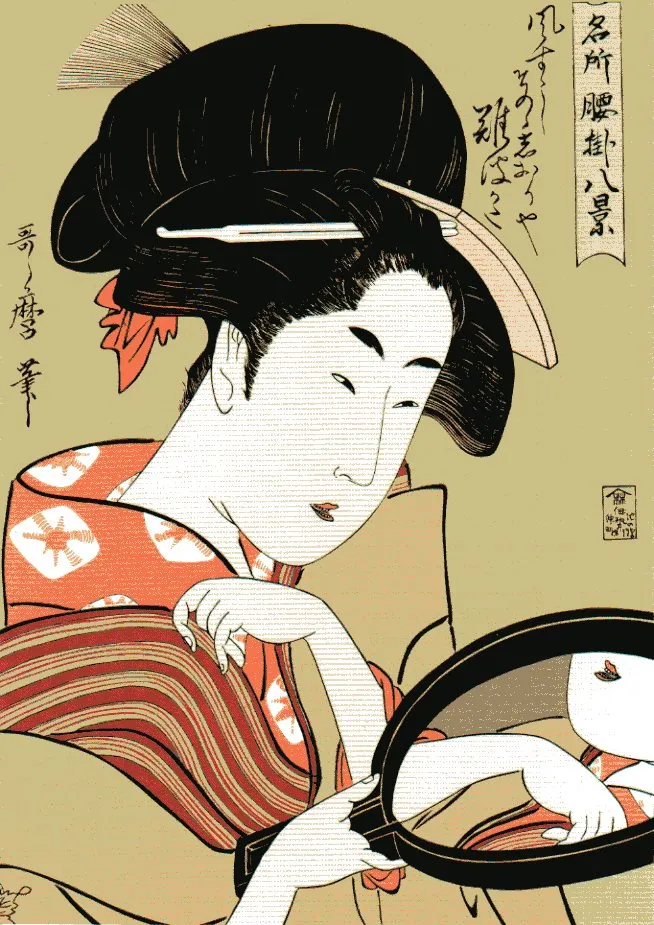
Photo: Kitagawa Utamaro, Public domain, via Wikimedia Commons
It started with a cup of coffee and a man named Ray.
Ray runs the bodega on my corner in Bushwick — the one with the cracked awning and the cat that judges everyone. One gray February morning, he handed me my cold brew and said, "You know I've been here twenty-two years? I know everybody's name." And something clicked in my brain that had clearly been waiting for an excuse: Ray is a merchant. A proper Edo-period merchant. He just doesn't know it yet.
That night I drew him as one. Flowing robes instead of a Knicks hoodie. A ledger instead of a lotto ticket stack. The posture, though — the posture was pure Ray. Shoulders back, chin up, the quiet authority of a man who has seen every possible version of 7 a.m.
I posted it. People loved it. And a challenge was born: one neighbor a day, every day, for 100 days, rendered as a ukiyo-e woodblock print.
Why Edo? Why Here?
Ukiyo-e — "pictures of the floating world" — was pop art before pop art. In 18th- and 19th-century Japan, block printmakers documented actors, courtesans, fishmongers, firefighters. Not kings. Not generals. People. The famous ones, sure, but also the guy hauling squid at the fish market. There's a print series by Kuniyoshi of warriors drawn as townspeople, and honestly, half of them look like they're waiting on the L train.
That's the whole thesis of the project. The floating world isn't Kyoto or Edo. It's wherever you are, if you squint right. My floating world is a four-block radius with two dollar vans and a guy who plays saxophone outside the dollar van.
The Rules I Gave Myself
Every artist needs constraints or we spiral, so I set four:
- The subject must be real and local. No celebrities, no friends visiting from out of town. They have to actually live or work in the neighborhood.
- One brush, one ink. Sumi ink on washi paper. If I messed it up, the mess stayed.
- Ask permission. Always. Which, honestly, became the best part of the project — but more on that in a second.
- No explanation until after. I'd show the finished print and let them react before I said anything.
Rule three sounds obvious, but it changed everything. I've been drawing strangers for years the way photographers sometimes shoot from across the street — at a distance, uninvited. Asking someone to sit for five minutes while you sketch them? That's a different contract. It's slower. It's intimate in a way that Americans, especially New Yorkers, have been trained out of.
What Americans Look Like Through an Old Japanese Lens
Here's what surprised me most: the ukiyo-e conventions fit.
The woman who dances on the J train platform between Marcy and Hewes — the one with the sneakers and the speaker strapped to her backpack — I drew her as a kabuki actor mid-pose. Kabuki's exaggerated mie posture, the frozen moment of maximum intensity? That's literally what she does when the doors open. She strikes. The visual language translated without me forcing it.
The retired mailman who feeds pigeons by the laundromat became a scholar in a garden, minus the garden, plus a flock of pigeons that I swear drew themselves. The teenage skater who ollies off the same curb every afternoon became a samurai — not because of any warrior fantasy, but because of the focus. The repetition. The way he treats that curb like it owes him something.
There's a term in Japanese portraiture: okuyū, roughly the idea of depth behind the face — the suggestion that there's a whole life beyond what's visible. Ukiyo-e artists were masters of implying it with minimal marks. Three lines and you believe the fishmonger has a daughter he's proud of.
And that, I think, is what the lens revealed about my neighbors: Americans are constantly told they're too busy, too transactional, too much. But when you draw someone as if they deserve the same treatment as a Kabuki star — careful linework, real attention, a hundred days of showing up — people soften. Ray framed his print. It's behind the register now. The cat is in it.
The Days That Broke Me
Day 41, I got rejected six times in a row. Day 67, I had the flu and drew the pigeon guy from memory, which felt like cheating and looked like it. Day 88, a woman I'd drawn — the florist on Wilson — told me her mother in Puebla had printed it out and put it on the fridge. I went home and sat in the dark for a while, in a good way.
Not every print worked. Some neighbors came out stiff, overworked, too careful. But in the spirit of the floating world, the failures stayed up too. You can see all 100 on my studio wall, and the bad ones teach you more than the good ones, same as always.
Take the Prints. Seriously. They're Yours.
I've uploaded ten of my favorites as high-resolution downloads — Ray, the J train dancer, the pigeon scholar, and seven more. Print them, tape them up, give them to your own corner-store merchant. If this project proves anything, it's that your neighborhood is already a woodblock print series. It's just waiting for someone to pick up the brush.
Day 101 is tomorrow. I haven't decided if I'm stopping.