The Beautiful Weight of Books I Haven't Read Yet
Photo: John Holmes, CC BY-SA 2.0, via Wikimedia Commons
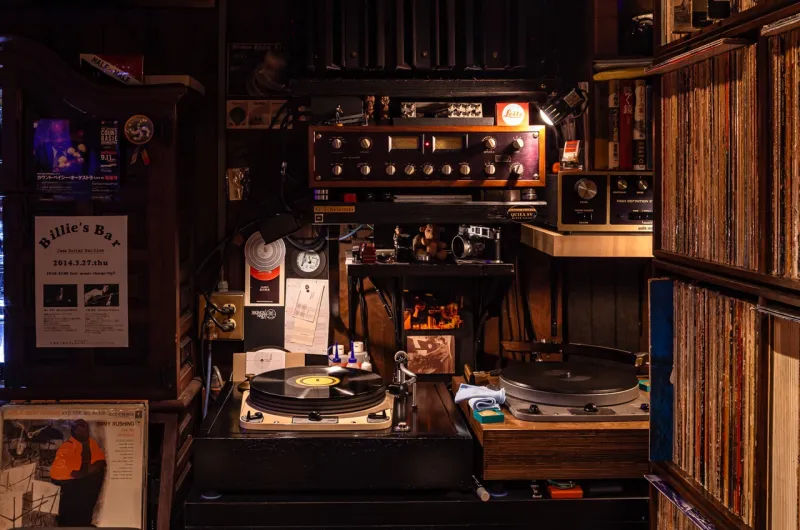
There is a stack of books next to my drafting table that has achieved what I can only describe as architectural ambition. Fourteen titles. The spine of the top one — a battered copy of Gilead — has created a small lean that, if disturbed, could take out my lamp. I have read exactly none of them.
In Japanese, there's a word for this: tsundoku. Buying books and letting them pile up, unread. The word has been around since the Meiji era, which tells you this is not a modern problem. It is a human condition with excellent posture.
But here in the United States, I've noticed something different. When American friends see my stacks, they don't see tsundoku. They see a to-do list. They see failure, pre-sorted.
The Stack as Self-Portrait
I started photographing my piles the way you'd photograph a houseplant — casually, then compulsively. And somewhere around the third roll of film, I realized what I was actually shooting.
Each stack is a self-portrait taken at a moment of hope. The week I bought those books, I was a person who intended to read them. The stack is evidence of who I was becoming, frozen mid-becoming. In that sense, an unread pile is more honest than a finished bookshelf. A finished shelf says "this is what I consumed." A teetering pile says "this is what I wanted." Desire, stacked vertically, dusted lightly.
Nihonga painting taught me that negative space is not absence — it's where the viewer lives. An unread book is negative space you can hold. The reading hasn't happened yet, which means all of its possible readings still exist. The moment I finish Infinite Jest, it becomes one book I've read. Right now, it's infinite.
Hustle Culture Hates an Unfinished Thing
The American instinct is to treat every book as a task with a deadline. Read 12 books this year. Track them. Log them. Optimize the pile. There are apps whose entire job is to make you feel behind on your own imagination.
Hustle culture can't metabolize tsundoku because tsundoku produces nothing. It doesn't optimize. It doesn't complete. It just... accumulates, the way a garden accumulates rain. And accumulation without output feels, to the American hustle instinct, like sin.
But ask any artist what actually feeds the work. It's rarely the finished things. It's the ambient, half-absorbed material — the book you read forty pages of, the album you played while painting, the novel that's been on your nightstand so long it's basically furniture. These unfinished things compost quietly into everything you make.
Other People's Piles
I asked a few fellow immigrant artists to send me photos of their own unfinished guilt, and the responses floored me.
A sculptor from São Paulo sent a photo of a half-carved cedar block she's kept for six years. "Every studio move, I almost throw it out," she wrote. "Then I don't. I think it's the most important object I own." A Vietnamese-American animator sent a screenshot of a folder called "someday" containing 200 unopened reference files. A Nigerian-born photographer in Chicago admitted she's never developed three rolls of film from a 2019 trip home — and now can't bear to, because the undeveloped version of that trip is still perfect.
The pattern was unmistakable: every artist I asked had a pile. And none of them could throw it away. The unfinished thing was functioning as a kind of promise — not to the world, but to a former self.
Reading the Pile
So here is my formal defense, as someone whose studio currently contains 47 unread American novels:
The pile is not a backlog. It's a landscape. It's the reading list of a person I trust myself to keep becoming. Some of those books I will read this winter, curled against a Brooklyn radiator. Some I will look at sideways for a decade, absorbing their spines the way you absorb a painting across the room. A few, honestly, I will never read, and they will still have done their job — because they were bought by someone hopeful, and hope is not refunded.
My grandmother in Kyoto keeps a shelf of books she calls her tomodachi — friends who are just visiting. They don't have to do anything. They just have to be there.
I've started calling my stacks the same thing. The pile by my drafting table isn't waiting for me to catch up. It's just keeping me company while I work.
That's not failure. That's an installation. And admission is free.